

Update (April 12): The original article, published March 9, 2026 as “MSD classified the Iran shock before VIX blew out. Here’s the tape.” covered three transitions mid-crisis. The episode is now complete. This version includes the full tape: 6 regime changes, 28 trading days, Calm through crisis states and back to Calm.
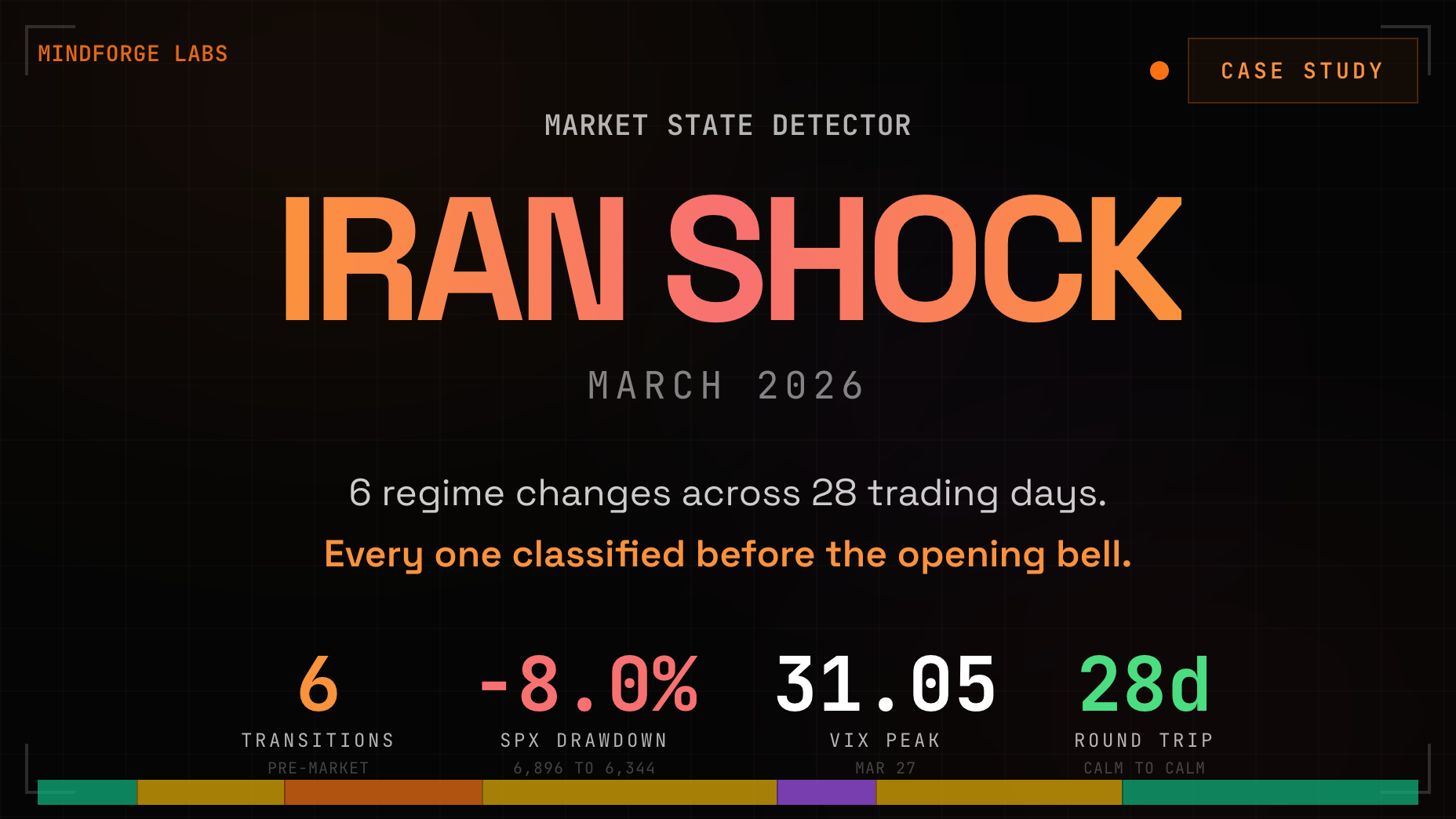
The Market State Detector (MSD) system generated escalated regime classifications during the March 2026 Iran Crisis, with no knowledge of Operation Epic Fury. No knowledge of the Strait of Hormuz. No knowledge of surging Oil.
The S&P 500 fell 8% peak-to-trough. VIX hit 31.05. South Korea triggered circuit breakers.
Here’s what Mindforge’s Market State Detector classified — each day, before market open:
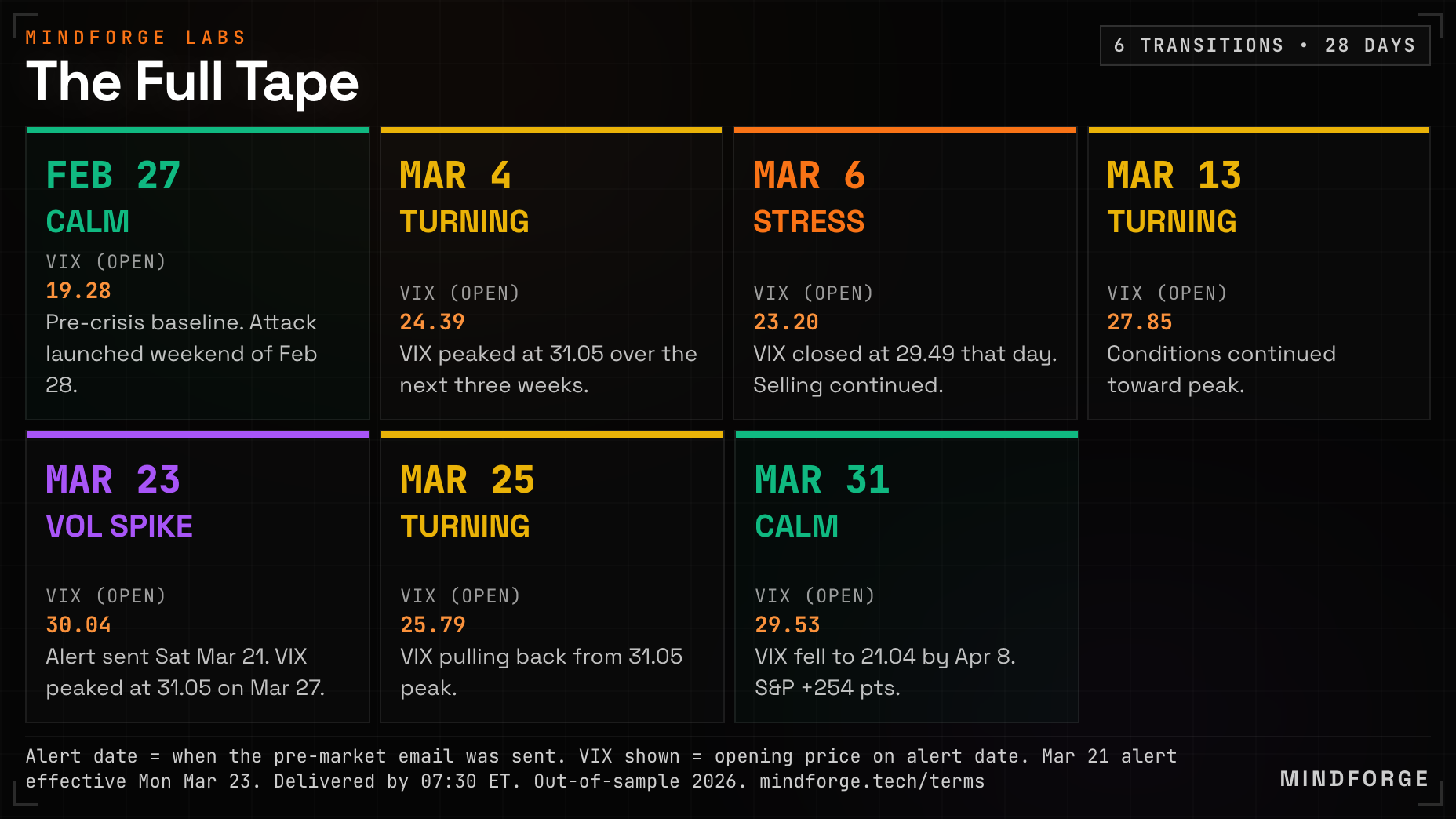
*CORRECTION: For Mar 25, the caption should read: “VIX peaked two sessions later on Mar 27, then rolled over.”
Six transitions. 28 trading days. Every classification generated pre-market by 07:30 ET. Same deterministic rules validated on 2012–2024. No modifications, no overrides.1
What Is Market State Detector?
A rules-based, daily market state classifier built on environmental inputs orthogonal to price. Not ML. Not a black box. Deterministic and auditable. Five states, one automated classification per trading day, timestamped before the opening bell.
Six years of daily classifications — 2020 through 30 days ago — are available to download and verify. The archive updates from automated system output.
mindforge.tech/market-state-detector
Tracking the Full Episode - Six Inflections.
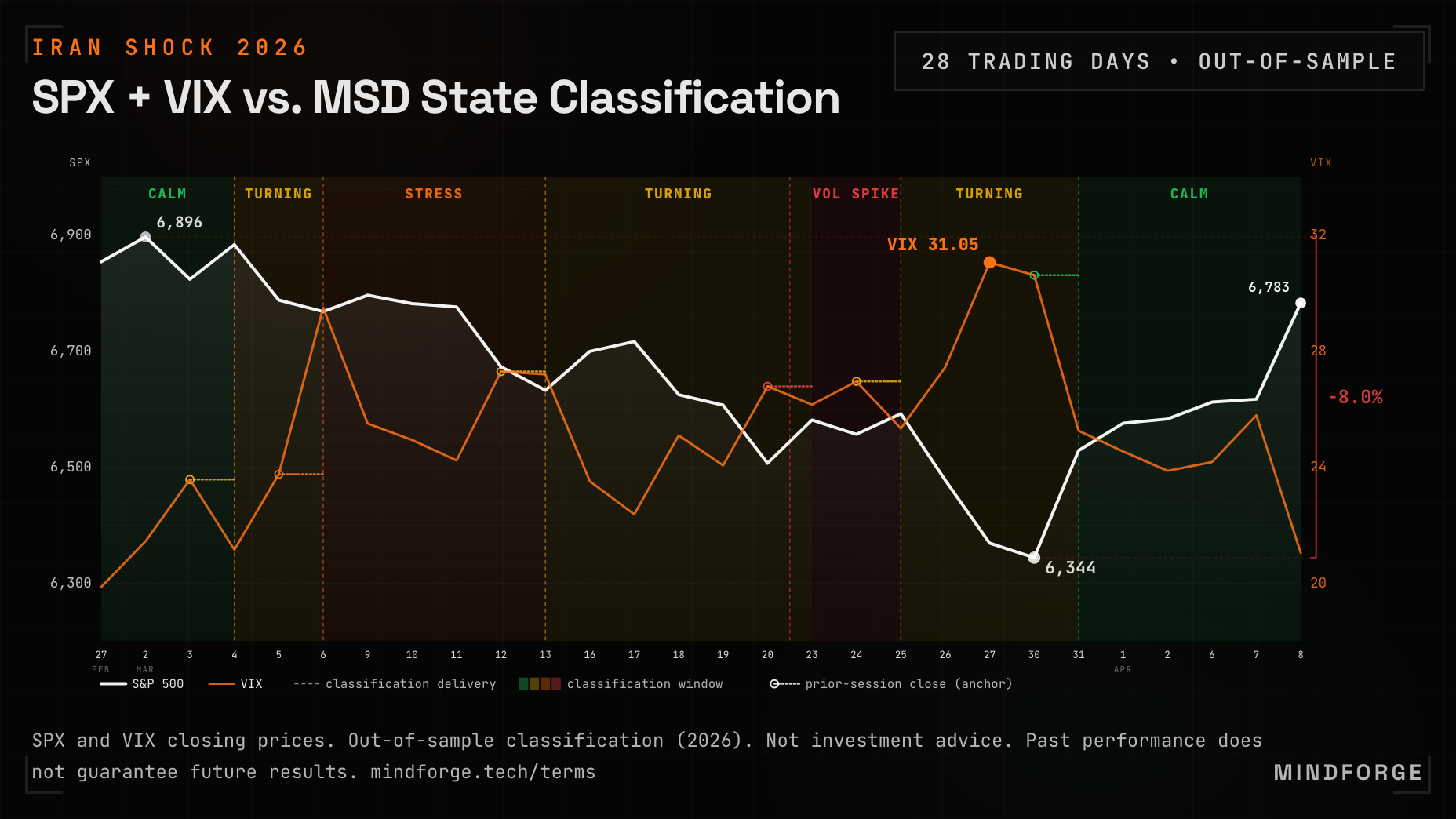
Turning classified on March 4, before the selling accelerated. Stress on March 6 as conditions worsened. The Vol Spike classification generated on Saturday, March 21, as volatility spiked sharply the trading days after. The system didn't just say "risk is elevated." It differentiated between stress, a sudden volatility jump, and the transitional periods in between.
That granularity matters. The difference between Stress and Vol Spike is the difference between hedging and hedging aggressively. Turning in between tells you conditions are shifting — not resolved, not at peak. Each state carries a different posture.
Calm at VIX 31. Five days before SPX recovery.
This is the part of the tape that didn’t exist when the original article was published.
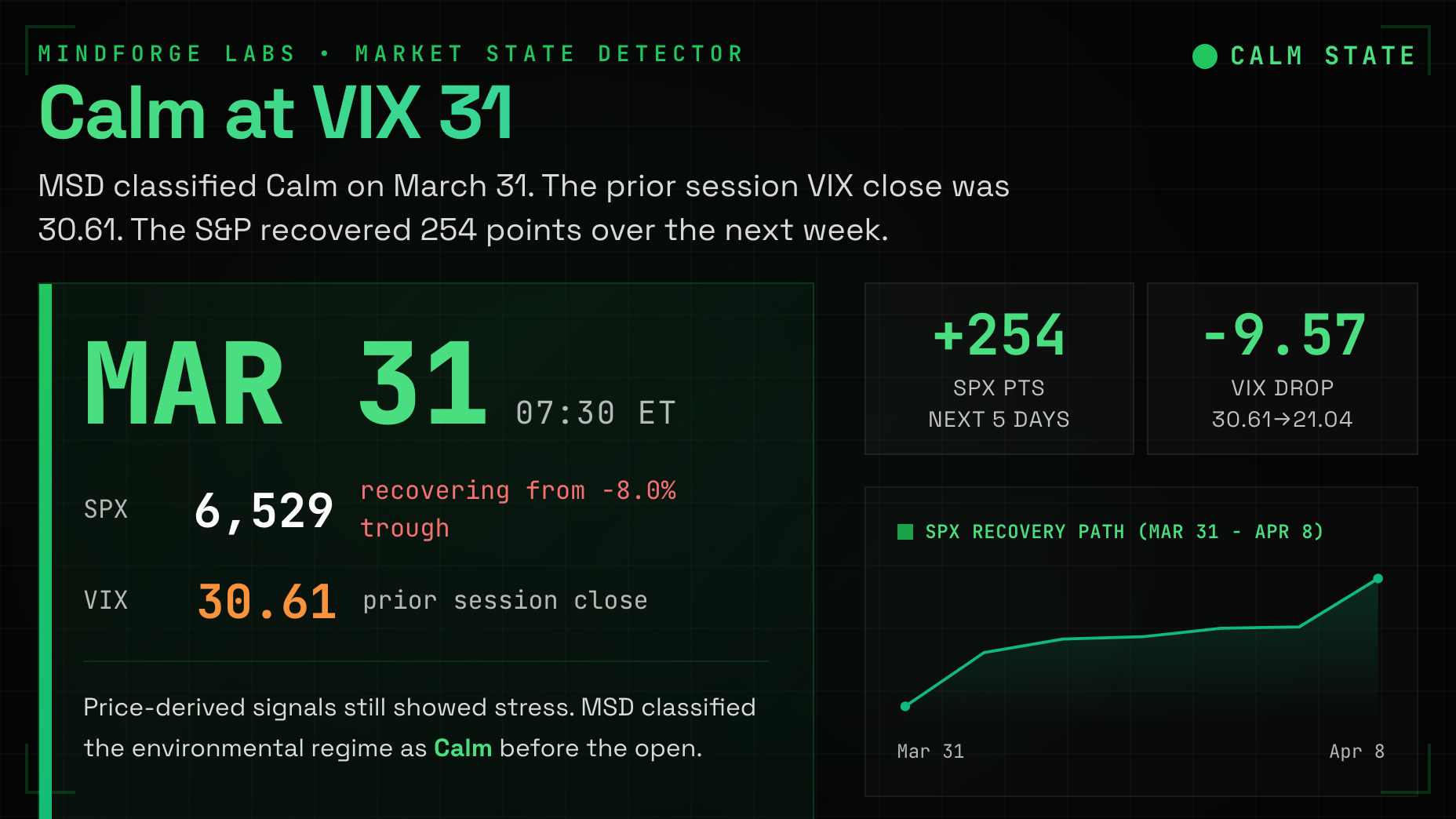
On March 31, the prior session VIX close was 30.61. Headlines were still running crisis narratives. Price-derived volatility indicators still said: stay defensive.
MSD classified Calm.
It could do this because its primary inputs are environmental — physical indices that operate on independent timescales from price. When those inputs normalized, the system said so, regardless of where VIX sat.
By April 8, VIX was 21 and the S&P had recovered 254 points.
If your signal reads only VIX, it can’t tell you the regime has normalized while VIX is still elevated. You have to wait. And by the time VIX confirms, the move is behind you. The divergence between MSD and price-derived signals isn’t noise. It’s the value.
Mindforge Classified the Initial Regime Shift Window as March 3rd → March 30th
The first Turning window classification came on March 4th. It stated the Turning episode window ran through March 30.
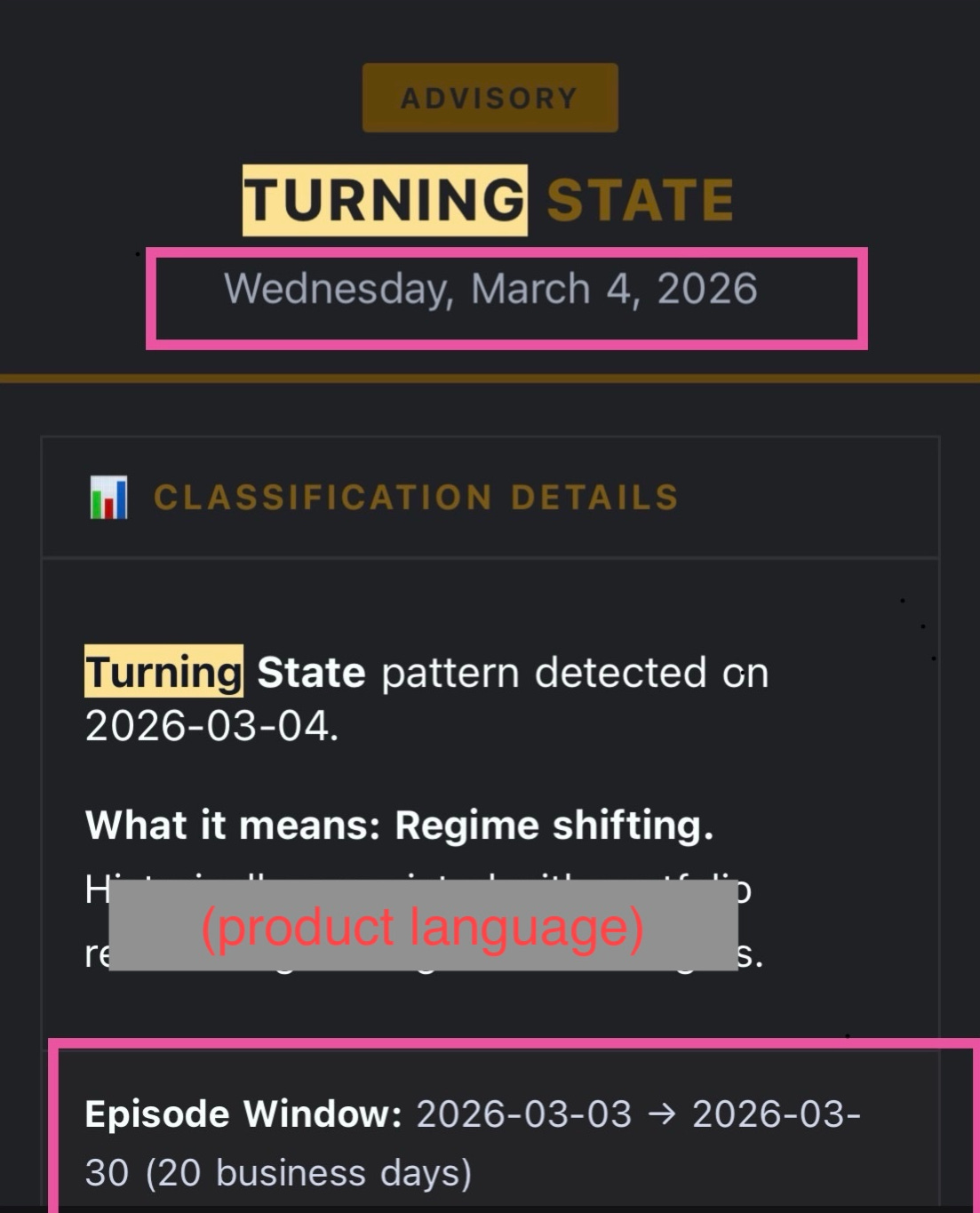
The S&P 500 bottomed at 6,344 on March 30. MSD classified Calm the next business day. From that March 31 Calm classification to April 8, the S&P recovered 254 points.
That window was not set in real time. It was set by the same deterministic rules validated on 2012–2024 data. When Turning classifies, the episode window is fixed at classification time based on historically calibrated durations — how long stress episodes of this type have persisted across a decade of validated data. The window captures the full stress lifecycle: onset, escalation, and resolution.
Between March 4 and March 30, MSD cycled through five state transitions — Turning → Stress → Turning → Vol Spike → Turning → Calm. That chop is normal. Multiple regime shifts within a single episode window reflect escalation and de-escalation within the same stress event. The original window held through all of it.
The bottom aligning with the window’s final day was on the favorable end of the system’s own distribution — not guaranteed, but not a coin flip. Episode windows are sized to capture resolution, not just onset. When stress persists for most of the window and resolves near its boundary, the calibration is doing what it was designed to do.
Research use only. Not investment advice. Past performance does not guarantee future results. Precision figures refer to MSD backtests (2012–2024). 2026 data is out-of-sample. Mindforge is not a registered investment adviser. Full terms: mindforge.tech/terms
SPX and VIX values are from Mindforge’s production market data feed at time of classification unless otherwise noted.