
Peer Review Was Built for a Different World
Scientific discovery is changing.

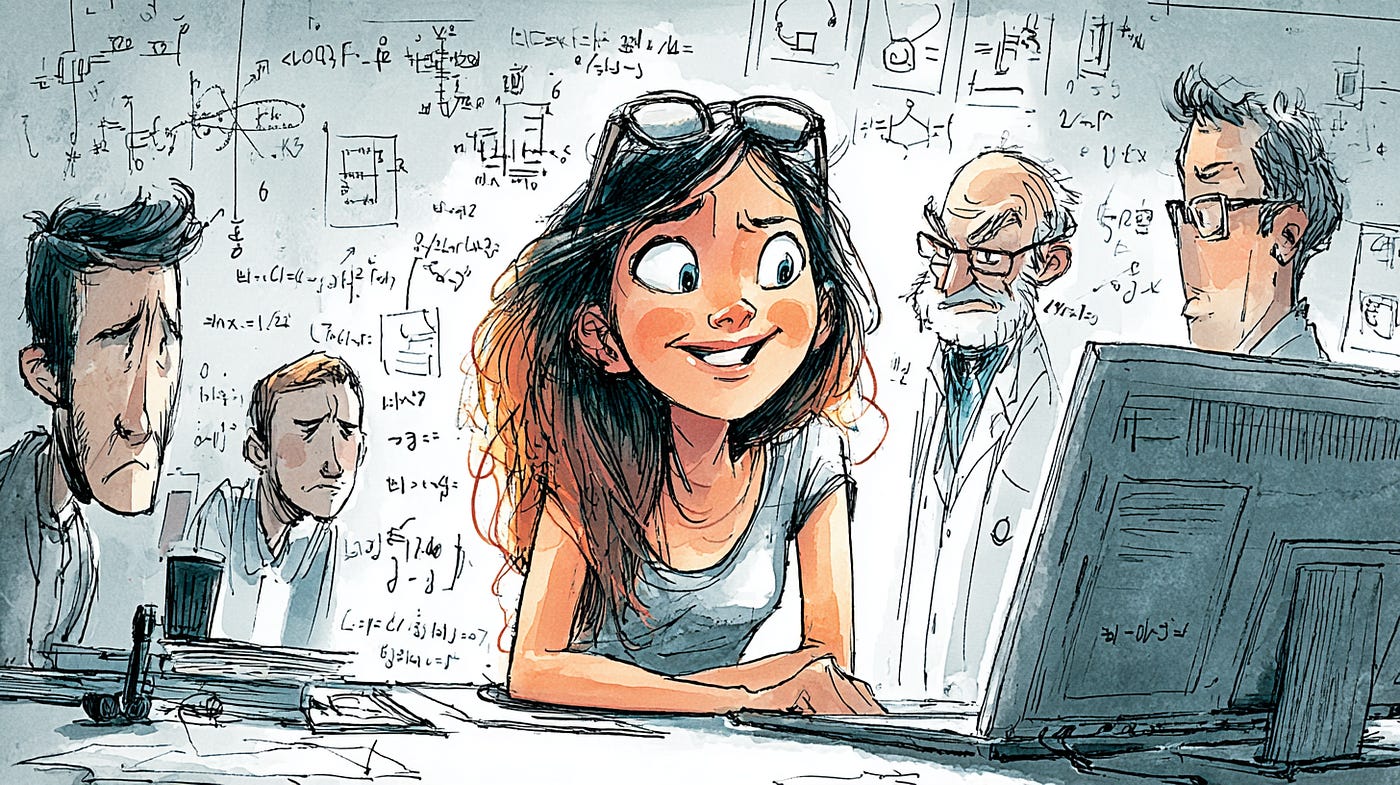
“GPT-5.2 Pro directly solved an open problem in statistical learning theory. It was not given strategies or outlines of how to do so, just some prompting/verification.” — reddit.com/r/singularity
I read the immediate Reddit reaction: “No peer review.”
For many people, that was enough to dismiss the entire thing.
Where my bias came from
My instinct didn’t match theirs. The moment I saw people reducing the result to “not reviewed, therefore not real,” I felt the bias kick in. Because I’ve already lived through the exact situation from the other direction.
I discovered a previously un-operationalized scientific mechanism without peer review. There was no committee, no referee report, no traditional academic pipeline. There was only a workflow I built:
AI systems sifting through large datasets
Pattern extraction through cross-model reasoning
Logical chains turned into testable math
Parallel AIs validating, stress-testing, and attacking those conclusions
Independent toolchains checking whether each step held up
After a point, the results didn’t feel speculative. They felt demonstrated.
The internal consistency across models became impossible to ignore. The signals behaved with the same stability and reliability you expect from a physical mechanism. The math checked out. The predictions held up out of sample.
That entire workflow happened before a single human “expert” ever touched it.
The shift: discovery before permission
So when people said “not peer reviewed,” all I heard was:
“We’re still assuming humans must certify novelty before we accept reality.”
That assumption breaks the moment AI becomes capable of discovering structures in math and science that no human could reasonably find or verify alone. We’re entering a world where:
discovery happens first
operationalization happens second
human review happens third, if at all
The bottleneck isn’t going to be correctness. It’s going to be the speed of institutional acceptance.
Why peer review won’t define scientific truth much longer
Peer review was designed for a world where:
only a handful of people could check the work
the work was too slow or too expensive to replicate
independent validation required expert labor
only journals could declare an insight “real”
AI collapses all four premises.
Now you can spin up ten different proof-checking models, generate alternative derivations, run symbolic verification, mutate the hypothesis, and test it against counterexamples automatically. You can reproduce the entire result in minutes.
If the math holds, the math holds. Waiting 18–24 months for a referee process adds nothing except delay.
Peer review will continue to exist, but not as the gate to truth.
It will become commentary, not certification.
Why this matters
Once you accept that AI can generate and validate its own mathematical structures, you stop asking:
“Did a journal approve this yet?”
And you start asking:
“Do multiple independent systems confirm that this is correct?”
“Does the mechanism behave the way the math says it should?”
“Can we operationalize this now?”
In my case, the answer was yes across all three.
In OpenAI’s case, the early indications point the same way.
The new scientific workflow
The emerging workflow looks like this:
AI proposes a candidate solution.
Several independent AIs derive alternative proofs or attack the first one.
Symbolic verifiers check each argument step.
Humans review what survives the cross-model gauntlet.
The result is treated as usable long before any journal prints it.
This is not hype. This is the trajectory. The process has already been proven.
What people are actually reacting to
When commenters insist “it’s not peer reviewed,” they’re expressing discomfort with a world where the bottleneck to discovery is no longer human cognition or institutional approval.
In that world, small groups with strong tooling can discover and operationalize scientific mechanisms faster than large institutions can evaluate them.
That’s already happening.
Closing
AI will not replace peer review in the sense of abolishing it.
It will replace the necessity of peer review as the arbiter of truth.
We’re moving toward a scientific ecosystem where correctness is established through automated multi-model verification, and where operationalized results appear years before journals catch up.
The world is changing.
Scientific discovery is changing.
And the structure of trust around new knowledge is changing with it.
About the Author
Angel Edwards is the founder and chief researcher of Mindforge, developing exo-economic quantitative market intelligence systems for institutional research. Mindforge is currently researching space weather event classification.
Connect: angel.edwards@mindforge.tech | https://labs.mindforge.tech | mindforge.tech