

There is a piece of market wisdom that sounds deeply intuitive:
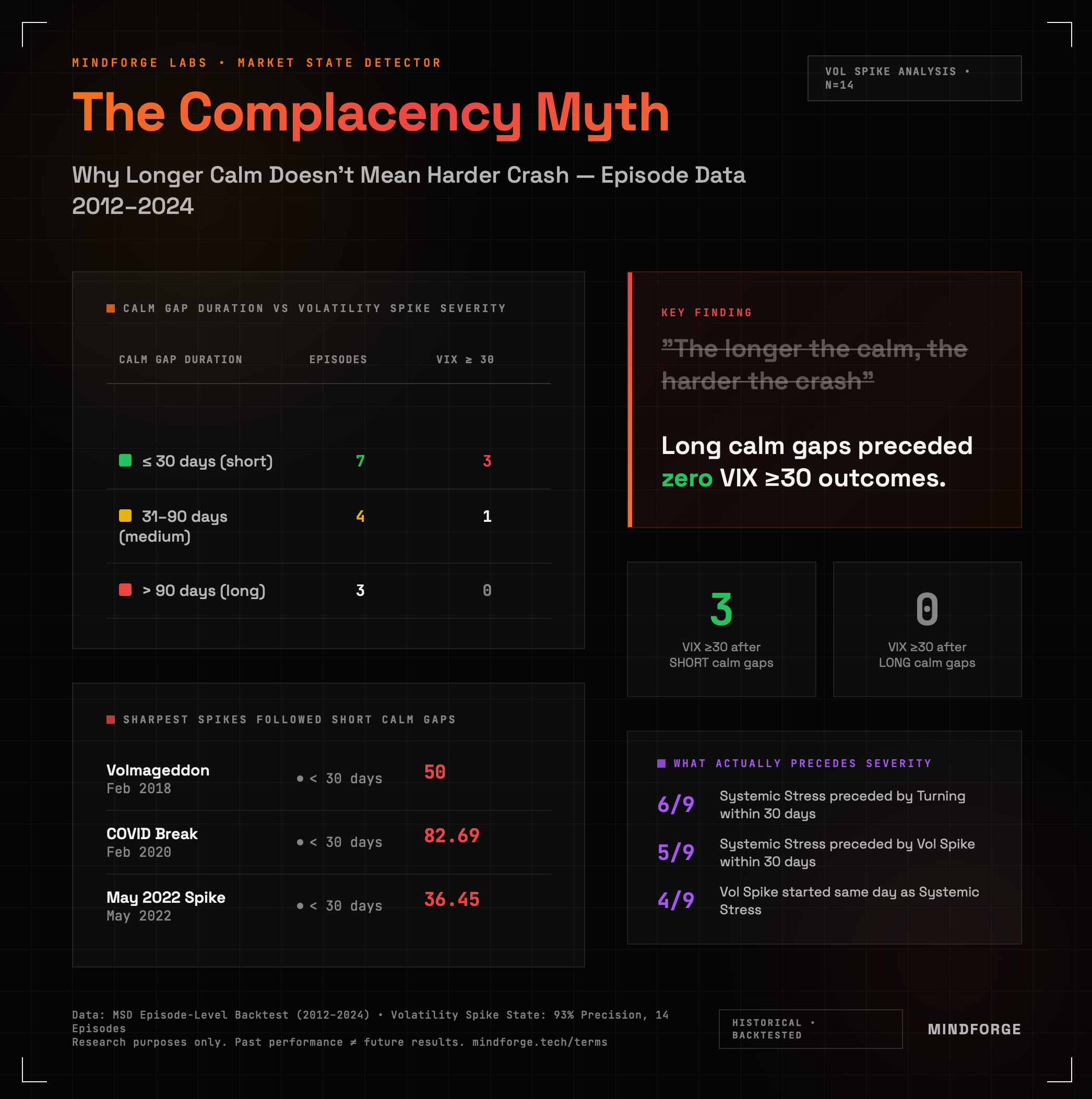
“The longer the calm, the harder the crash.”
The story is familiar. Extended quiet breeds complacency. Leverage builds. Risk models get lazy. When the break finally comes, it is brutal.
There is one problem. Our episode data does not support the claim.
The Conventional Wisdom
Every PM has heard some version of this:
“We’ve been quiet too long. A big move is coming.”
“VIX at 12 for six months means the next spike will be vicious.”
“Extended calm equals elevated fragility.”
The logic is straightforward. Long quiet periods should let risk accumulate silently. When volatility returns, that accumulated risk should release as a larger volatility event.
It is a reasonable hypothesis. We tested it.
What the Episode Data Actually Shows
We analyzed every Volatility Spike episode from 2012–2024 (14 total activations; 93% precision) and measured the Calm gap that preceded each one.
Key question: do longer Calm gaps historically precede more severe volatility episodes?
Calm gap duration vs. severity outcomes
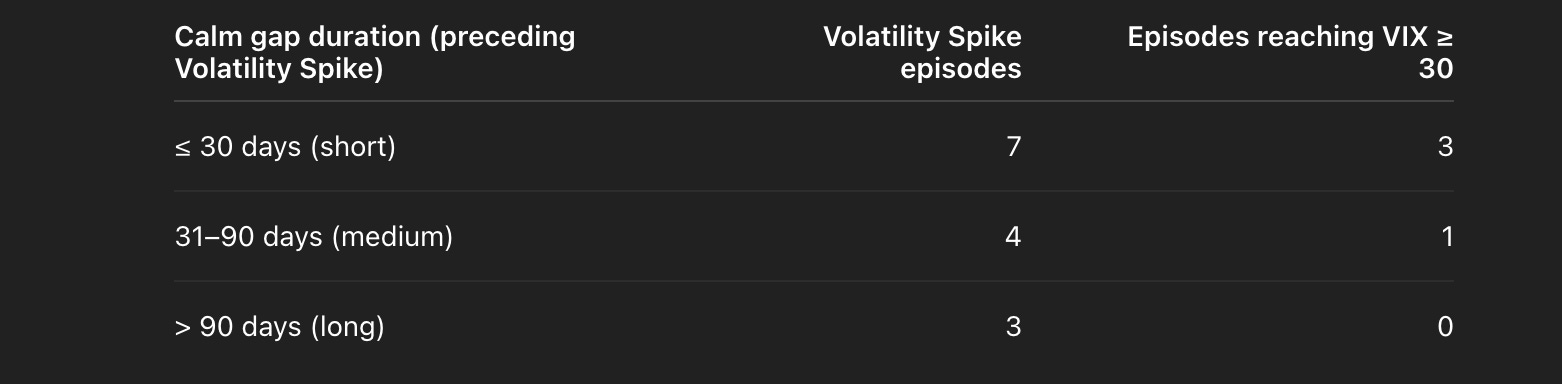
Short Calm gaps (≤30 days) preceded 7 Volatility Spike episodes, including 3 that reached VIX ≥30 (the severity threshold used here).
Long Calm gaps (>90 days) preceded 3 Volatility Spike episodes. None reached VIX ≥30.
The Sharpest Spikes Followed Short Calm Gaps
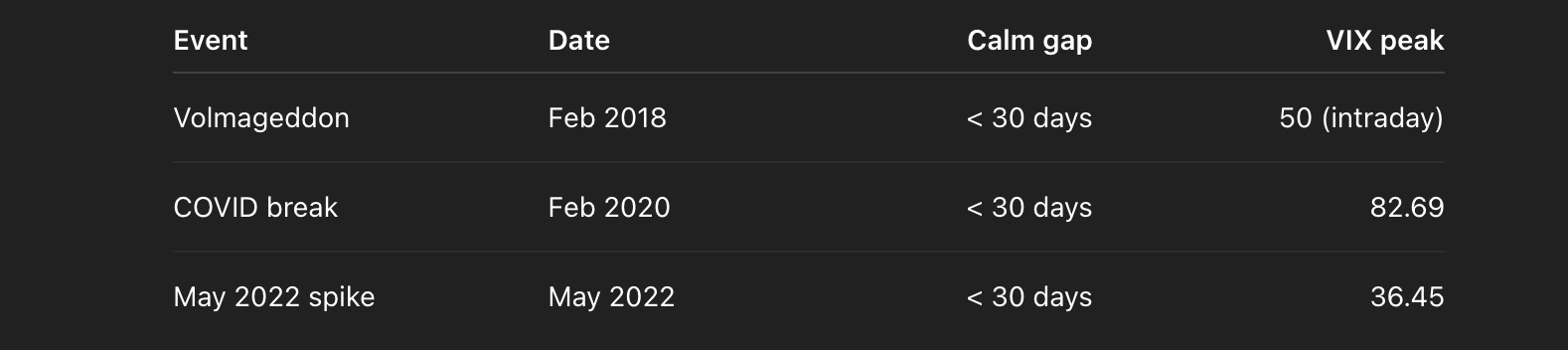
In this catalog, the largest VIX peaks occurred after short Calm gaps.
Why the Intuition Fails
Why does “longer calm equals harder crash” feel true?
Availability bias. Dramatic narratives are easier to recall than quiet counterexamples. A long calm period followed by a major volatility event becomes the remembered storyline, even when interim regime changes occurred.
Survivorship in memory. The brutal spikes are retained. The many cases where extended calm is followed by modest volatility do not become durable market lore.
Confusing correlation with causation. Long calm periods are less common. When a large move eventually follows, calm duration becomes an easy explanatory variable, even when severity is being driven by other state transitions.
What the Data Suggests Instead
This sample supports a different framing: calm duration is a weak severity feature on its own.
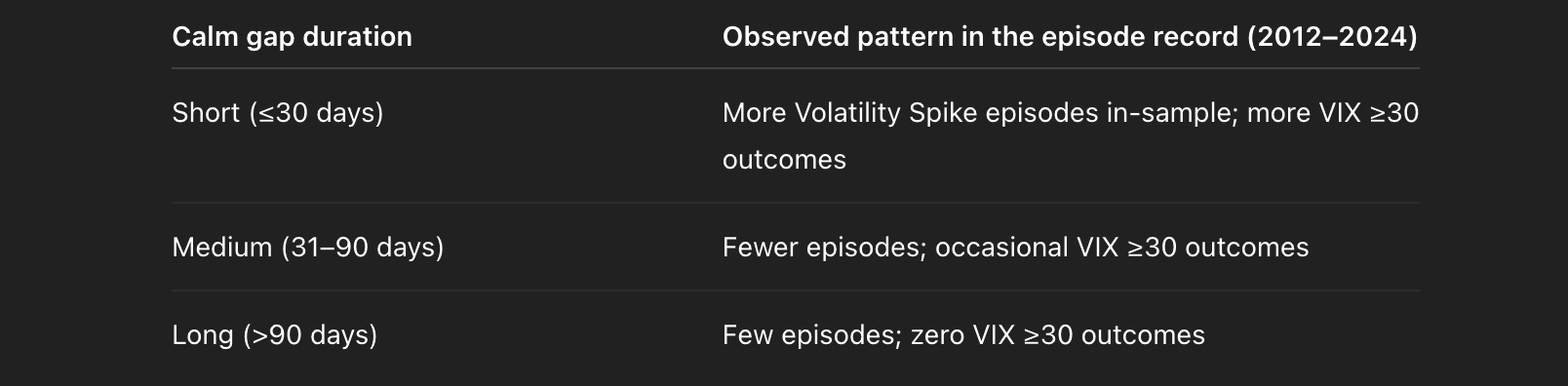
Important caveat: the sample is small (14 Volatility Spike episodes). These are observational patterns from one classification record, not a predictive rule.
A More Nuanced View
What does precede severe volatility more consistently than calm duration?
Looking at the 9 Systemic Stress episodes (2012–2024), state adjacency is more informative than “time since calm.”
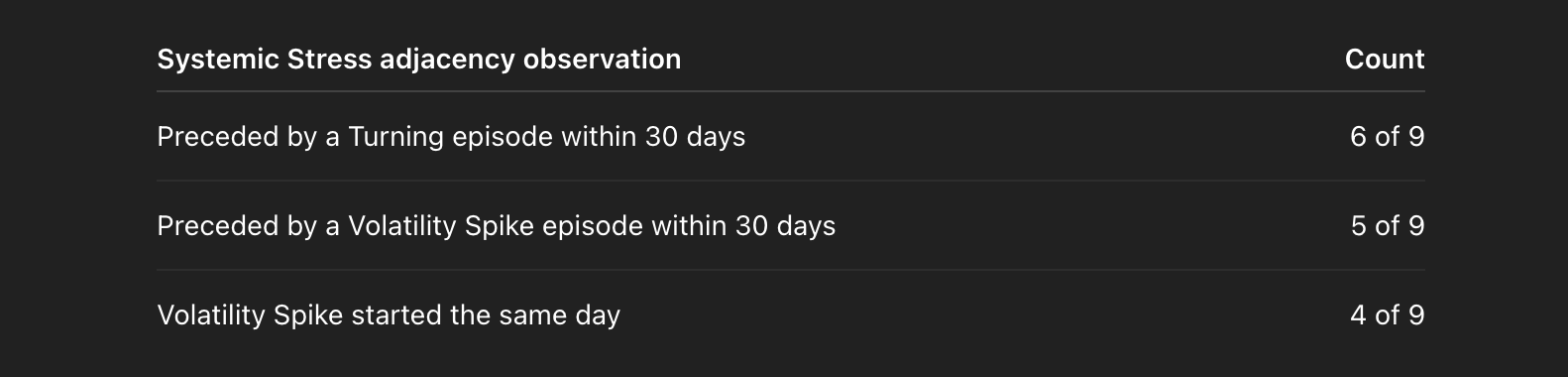
Systemic Stress rarely appears after an extended uninterrupted Calm regime in this record. It tends to cluster with other active states, often within tight windows.
The regime sequence carries more information than Calm duration.
Implications for Risk Managers
If you have been mentally weighting “days since last volatility event” as a fragility indicator, this dataset argues for de-weighting it.
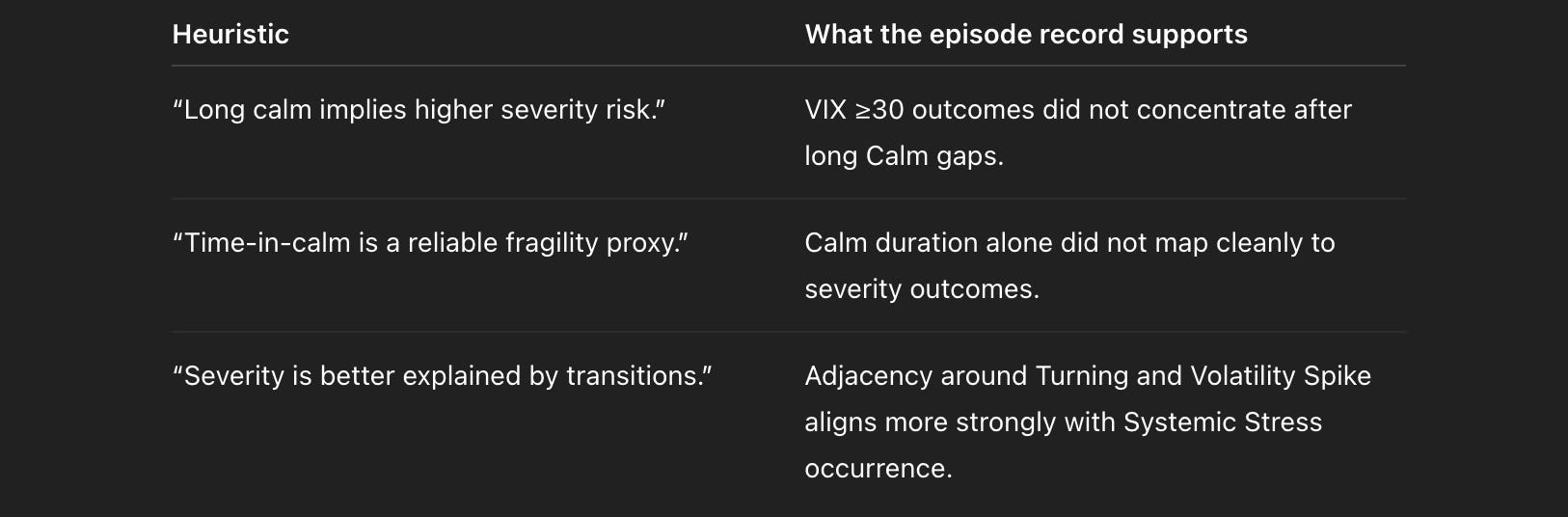
Complacency can be a risk. Calm duration has not behaved like its reliable proxy in this episode record.
Technical Note
This analysis is based on MSD episode-level backtesting (2012–2024):
Volatility Spike State: Classifies rapid VIX expansion (mid-teens to 30+ within days). 14 episodes, 93% precision, ~1.1 activations per year.
Calm State: Meta-state active when no stress states are active (~80% of trading days, VIX typically mid-teens).
Calm gap: Calendar days between the end of the prior non-Calm episode and the start of the next Volatility Spike episode.
Severity threshold: VIX ≥30 (a hit criterion for Volatility Spike State).
All episode dates and outcomes are documented in canonical manifests. The sample size is small. Conclusions should be treated as observational patterns, not predictive rules.
Disclaimer: Historical backtested data (2012–2024). Past performance does not guarantee future results. Market State Detector provides research classifications only, not investment advice. Mindforge is not a registered investment adviser. Full terms at mindforge.tech/terms.
Full methodology: mindforge.tech/validation-and-methods